
Shop / History
Magna Carta Summary
Magna Carta, Latin for "great charter", was a peace deal between King John of England and his rebel barons, sealed at Runnymede in June 1215. It failed within months, yet it became one of the most quoted documents in the history of law. Here is what it said, what happened to it, and why it still matters.
Sealed: 15 June 1215, at Runnymede beside the Thames
Who: King John and around 40 rebel barons
Length: 63 clauses
Annulled: by Pope Innocent III about ten weeks later
Still law in England and Wales: parts of clause 1, and clauses 13, 39 and 40
Why King John sealed it
By 1215 John had lost most of his lands in France, quarrelled with the Pope and squeezed the barons for money to pay for his wars. Many of the barons rebelled and seized London. Facing civil war, John met them in a meadow at Runnymede and agreed to their terms. Copies were sent across the kingdom to be read aloud. Australia's Parliamentary Education Office gives a short account of how it came about.
What the 63 clauses covered
Most of the charter is about feudal business, not grand principles: inheritance payments, widows' rights, debts, the royal forests, fish weirs on the Thames, the Church and the liberties of the City of London. Clauses 12 and 14 said certain taxes needed the "common counsel" of the realm. Clause 61 set up a council of twenty-five barons who could take action against the king if he broke the charter. We cover it in detail in Magna Carta clause 61 explained.
Two clauses stand out above the rest. Clause 39 says no free man shall be seized, imprisoned, stripped of his rights or possessions, outlawed or exiled "except by the lawful judgement of his equals or by the law of the land". Clause 40 adds: "To no one will we sell, to no one deny or delay right or justice." Clause 39 is the idea behind our Freeman T-Shirt, and clause 40 is printed on the Truth T-Shirt.
What happened next
The peace did not hold. John asked Pope Innocent III to cancel the charter, and he did, about ten weeks after Runnymede. War broke out again. After John died in 1216, his son's advisers reissued a shorter version, and it was reissued again in 1217 and 1225. In 1297 Edward I confirmed it, and that version went onto the statute roll. The US National Archives holds one of four surviving originals of the 1297 Magna Carta. Four copies of the 1215 charter survive: two at the British Library, one at Lincoln and one at Salisbury Cathedral.
Which parts are still law?
Almost all of it has been repealed. What survives in England and Wales comes from the 1297 statute: part of the clause on the freedom of the English Church, the clause protecting the liberties of the City of London, and the famous lines from clauses 39 and 40, which were joined into one chapter by 1225. You can read the current text on legislation.gov.uk.
Why it still matters
Magna Carta was written to protect barons, not ordinary people. But its wording, "no free man" and "to no one", reached further than its authors intended. Lawyers in the 1600s used it against the Stuart kings, and colonists took it to America. It influenced the US Declaration of Independence and Bill of Rights, the Australian Constitution and the Universal Declaration of Human Rights. The core idea is simple: the ruler is under the law, not above it. That is the idea on our People Over Power T-Shirt.
Wear the history
Many Lawful Rebellion Co. designs start with a real line or date from this history. See all of our Magna Carta t-shirts, read what lawful rebellion means, or browse the full range. (This page is history, not legal advice.)
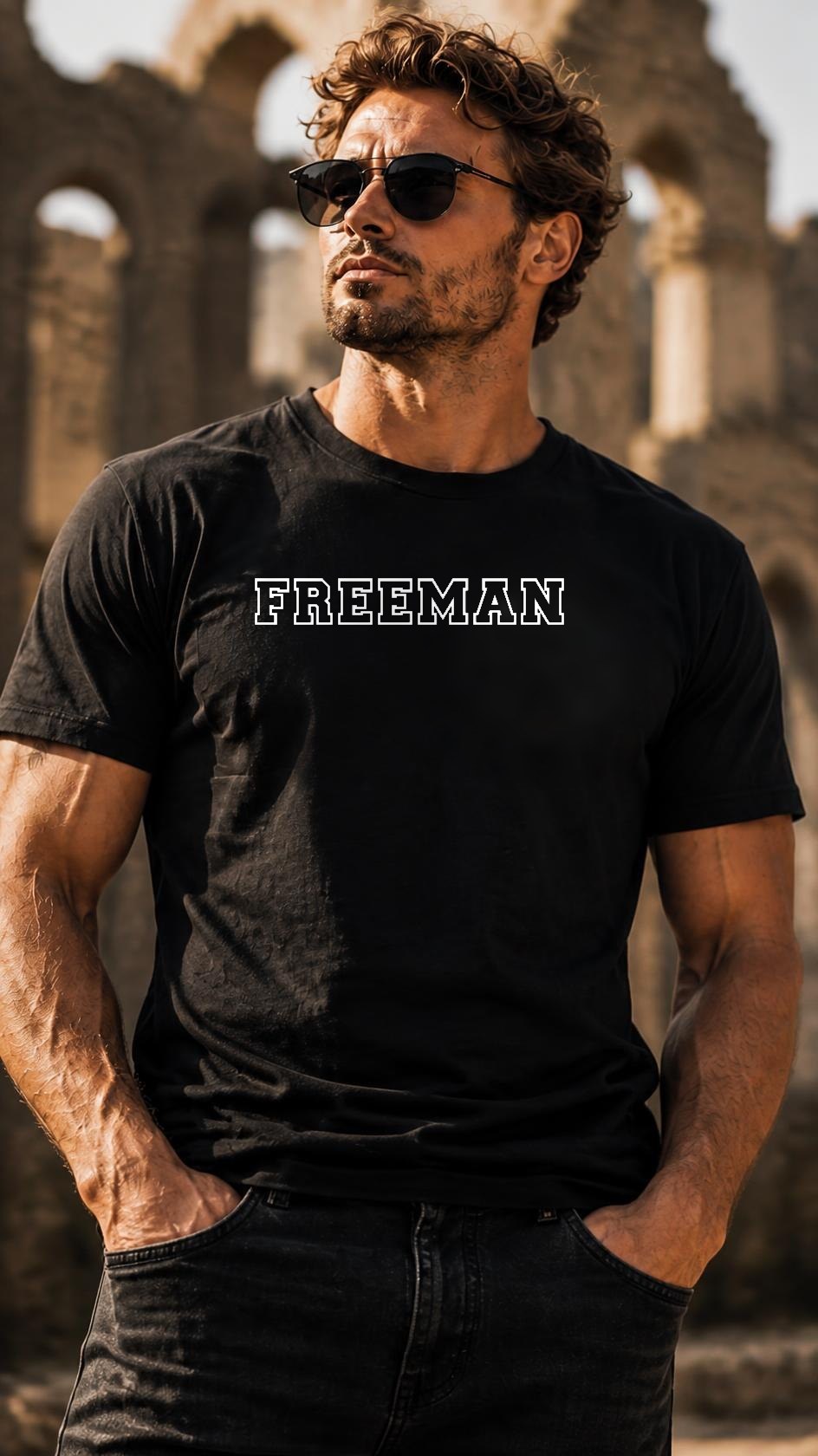 Freeman T-Shirt
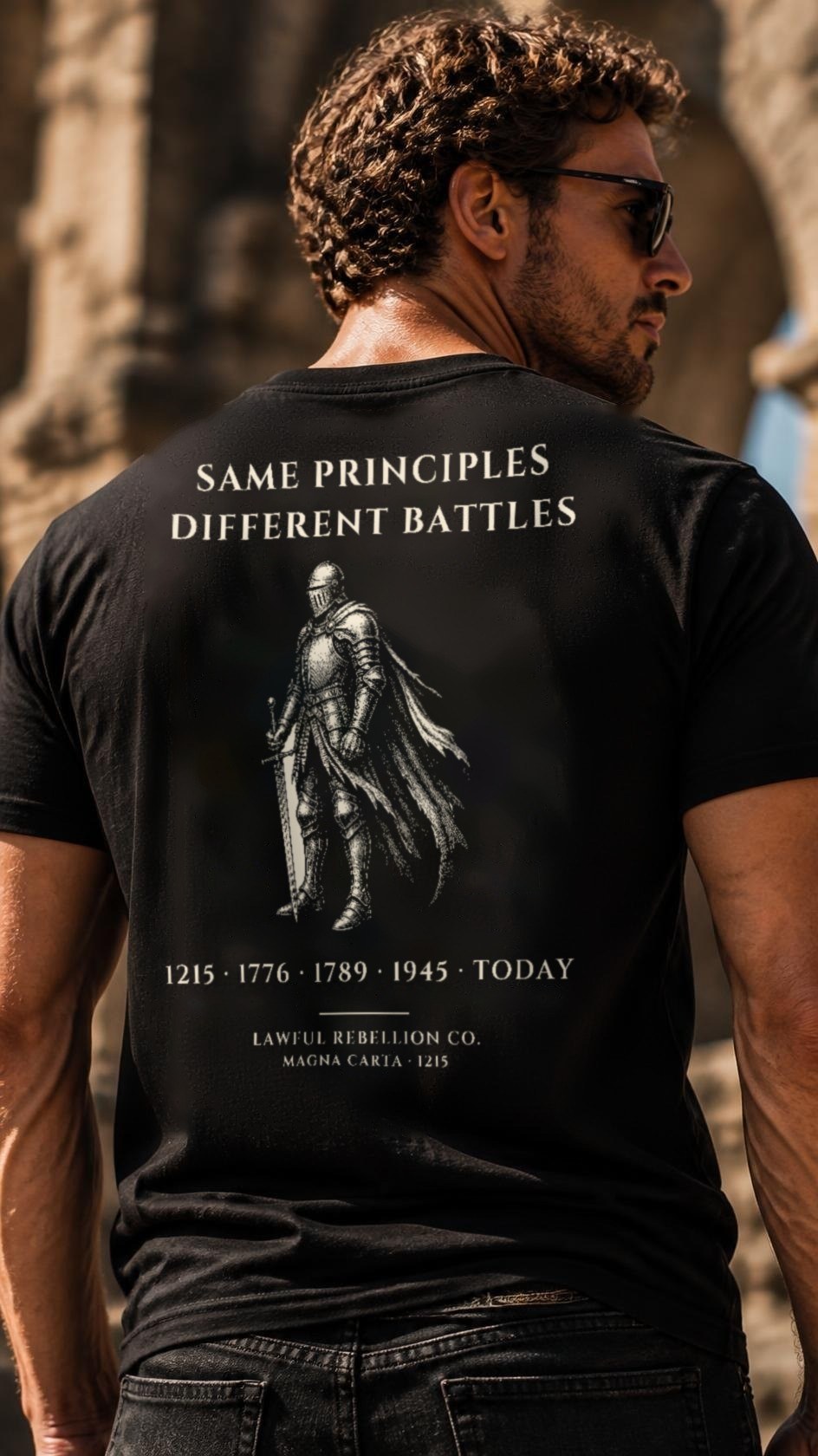 Truth T-Shirt
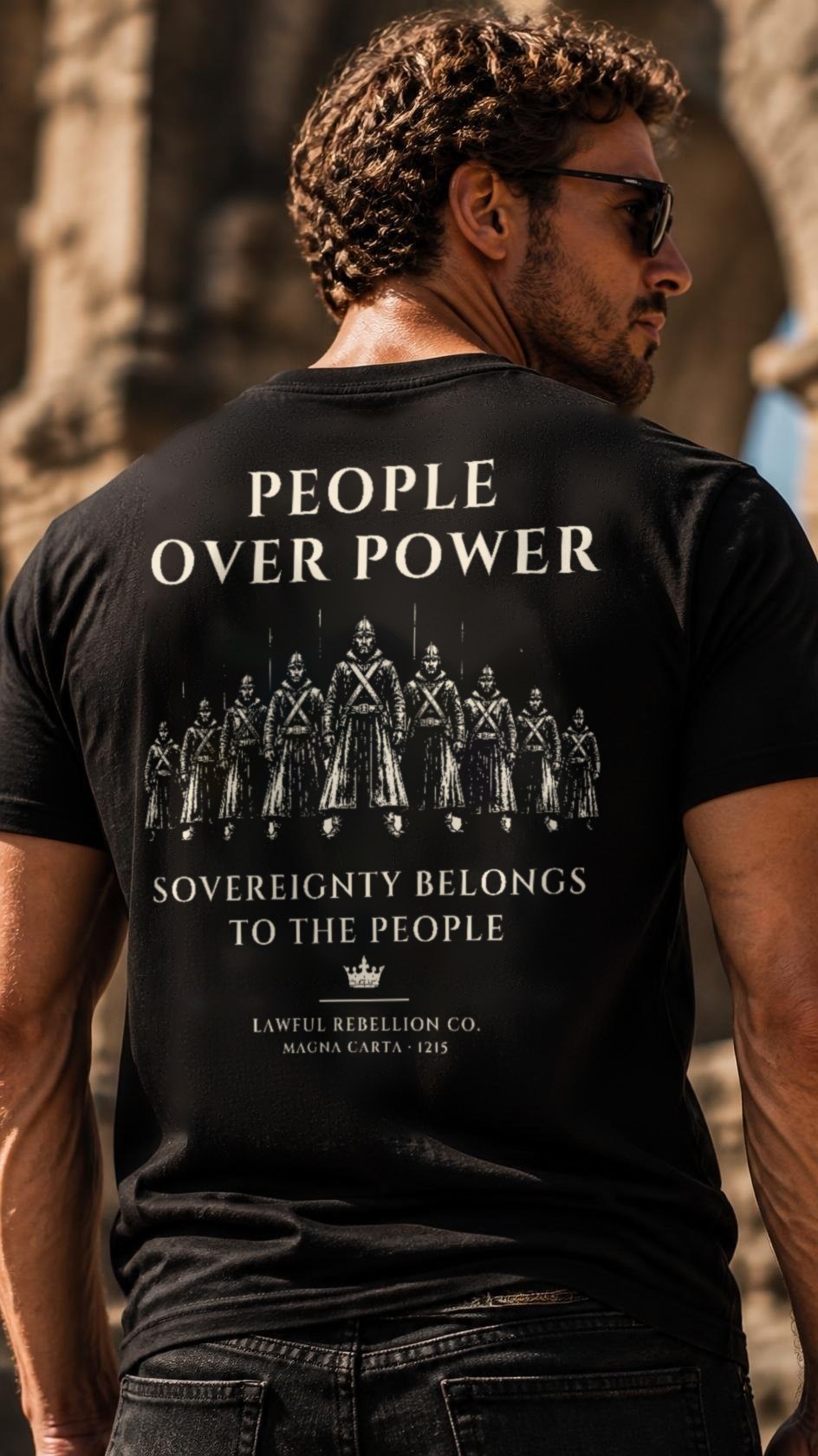 People Over Power T-Shirt
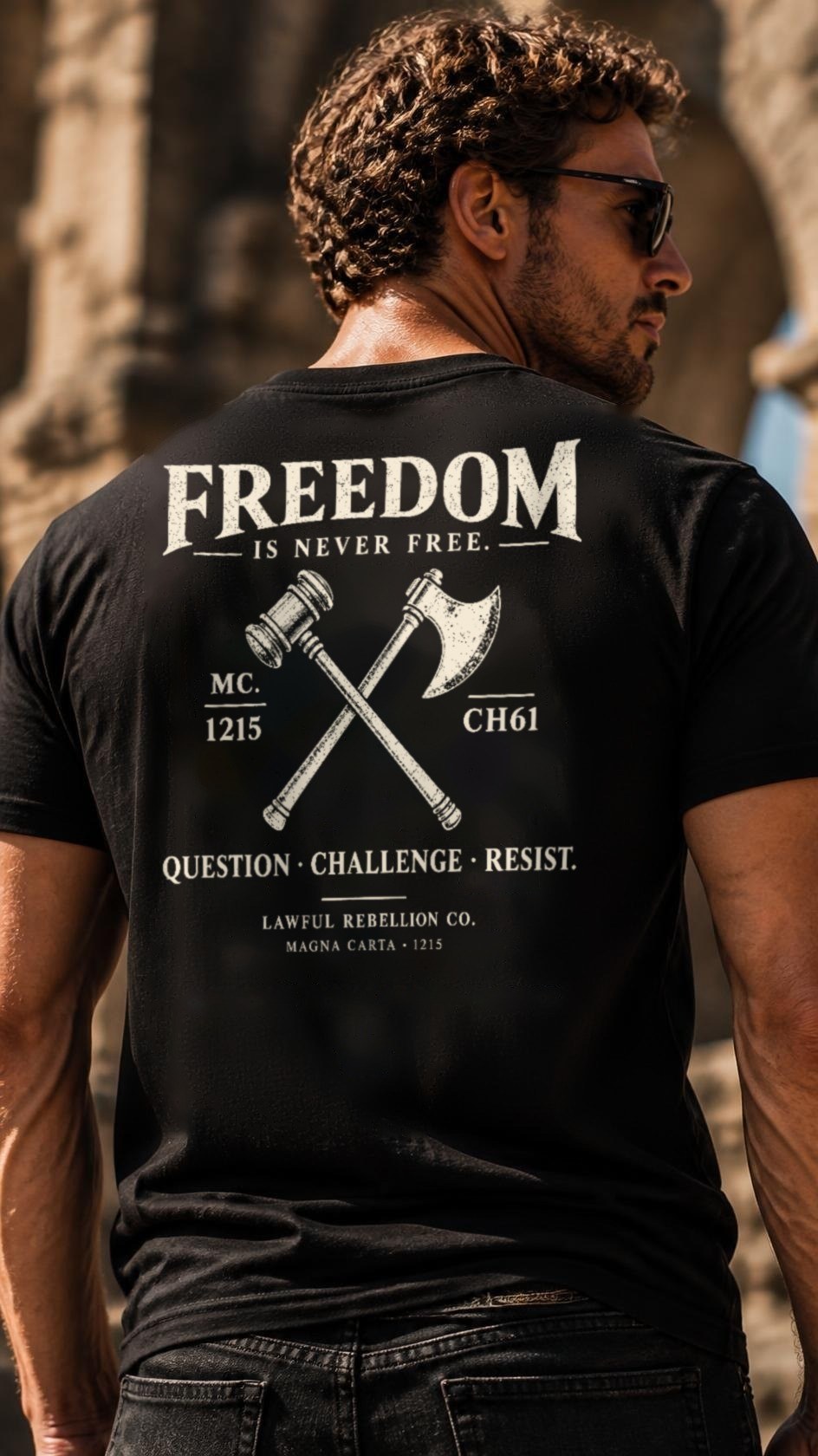 Freedom is Never Free T-Shirt